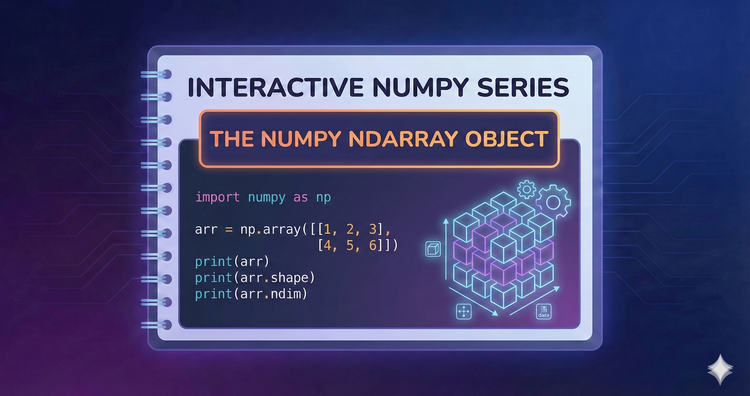
Interactive NumPy Series - The NumPy ndarray Object
We examine the ndarray, NumPy’s core structure for efficient storage. You'll learn how contiguous memory layout and specific data types (dtype) enable vectorization, replacing slow loops with high-speed operations.
Linear Algebra Series - Special Topics
We round out the course with advanced frontiers. From Jordan Canonical Forms for defective matrices to an introduction to Tensors, these topics bridge the gap between standard linear algebra and advanced theoretical physics or machine learning research.
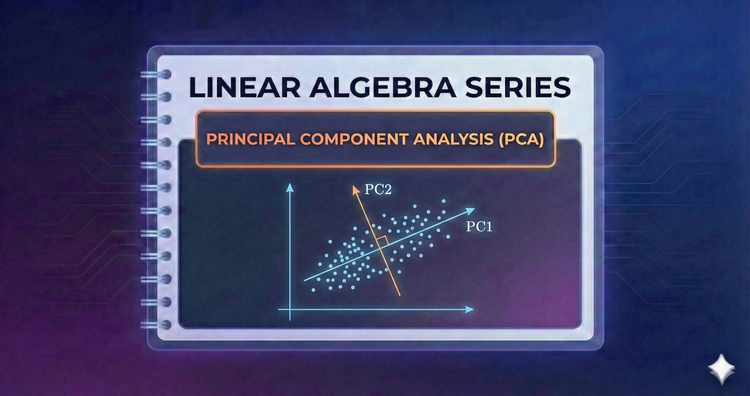
Linear Algebra Series - Principal Component Analysis (PCA)
In the age of Big Data, we have too many variables. PCA uses linear algebra to reduce dataset dimensionality while keeping the most important information, simplifying complex data clusters into understandable, actionable patterns.
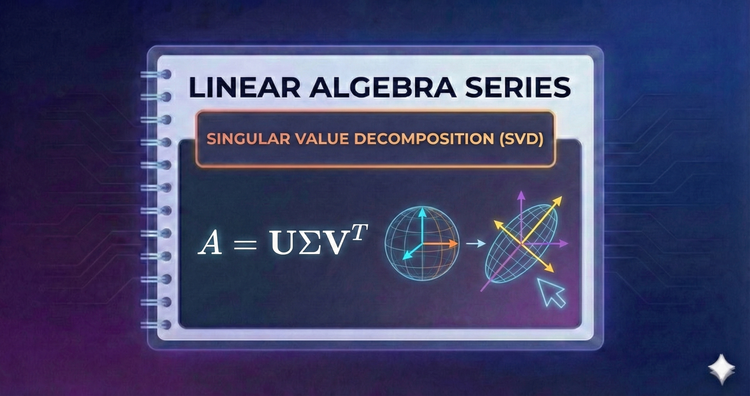
Linear Algebra Series - Singular Value Decomposition (SVD)
The pinnacle of linear algebra, SVD works on any matrix. We learn to break a matrix into strictly orthogonal components, a technique crucial for image compression, noise reduction, and modern recommendation systems.
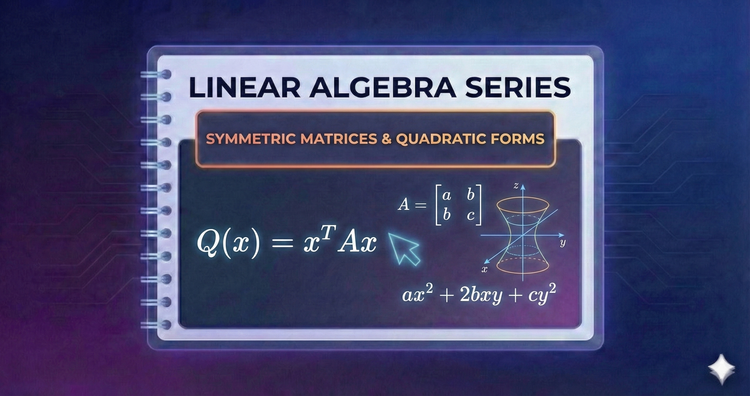
Linear Algebra Series - Symmetric Matrices and Quadratic Forms
Symmetric matrices appear frequently in physics. We explore the Spectral Theorem, which guarantees beautiful orthogonal properties, and use them to analyze the geometry of Quadratic Forms to visualize ellipsoids, paraboloids, and saddles.
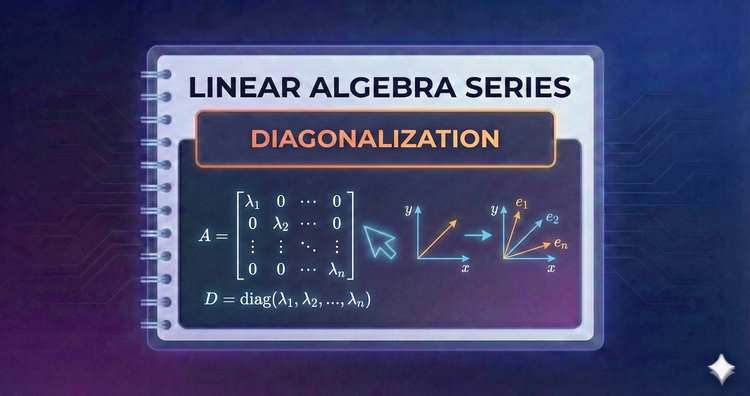
Linear Algebra Series - Diagonalization
Complex systems are hard to analyze when variables interact. Diagonalization uncouples these dependencies, transforming a tangled matrix into a simple diagonal form that makes computing high powers and predicting long-term trends trivial.
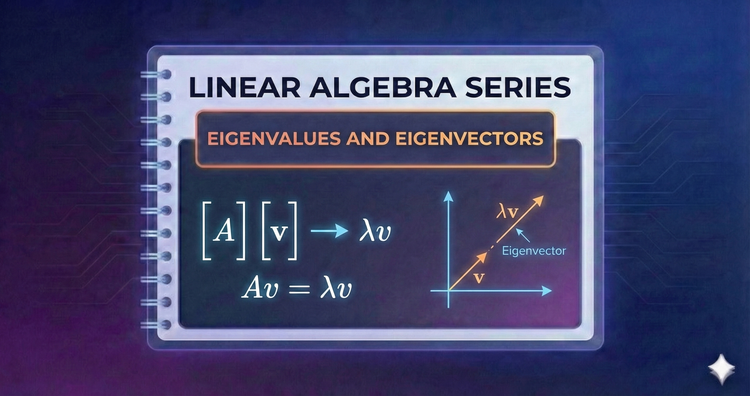
Linear Algebra Series - Eigenvalues and Eigenvectors
Most vectors change direction when transformed, but Eigenvectors stay on path. Finding these vectors and their scaling factors (Eigenvalues) unlocks the "DNA" of a matrix, explaining system stability, vibration modes, and growth patterns.
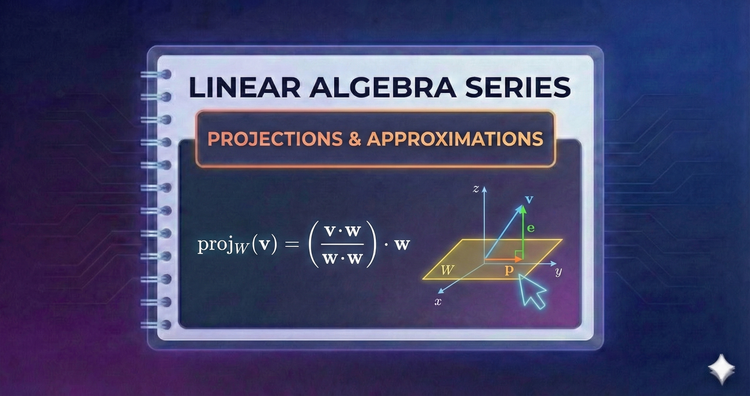
Linear Algebra Series - Projections and Approximations
Real-world data is rarely perfect. When exact solutions are impossible, we use Orthogonal Projections and Least Squares to find the "best possible" approximation—the mathematical foundation of linear regression and data fitting.
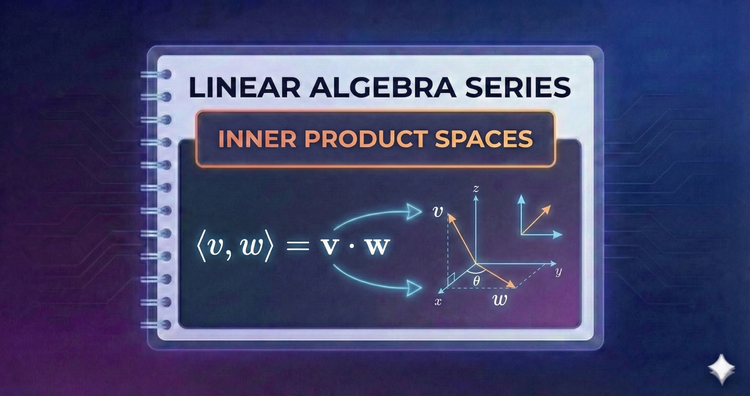
Linear Algebra Series - Inner Product Spaces
Geometry requires measurement. By generalizing the dot product, we gain the ability to measure lengths and angles in abstract spaces, defining precisely what it means for two complex functions or signals to be perpendicular (orthogonal).
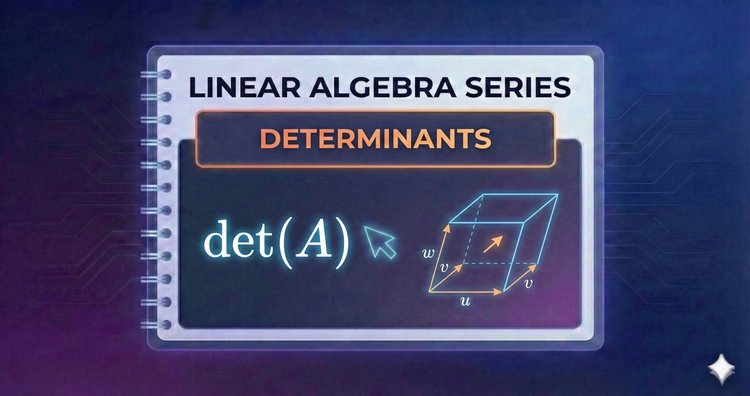
Linear Algebra Series - Determinants
The determinant is a single number revealing a matrix's character. We use it to measure how transformations scale area or volume, and as a definitive test to check if a system is solvable or if a matrix can be inverted.